Friday, April 1, 2016

The Beauty of Willows

Jim (the owner of Bluestem Nursery) has a brother who lives in Ohio. Frank not only also grows willows and ornamental grasses, but he loves to photograph them.
On March 27 he took the following pictures of Salix rubens 'Hutchinsons Yellow' with Salix chaenomeloides (Japanese pussy willow):
Frank said, "The pictures really don't do justice to how beautiful this tableau has been."
I can't imagine them looking even more beautiful in person!! Thanks for sending them Frank.


Monday, April 1, 2013

Solving a Lawn Problem in San Diego - March 2013 Update

From George Baboi:

"Well, over a year has passed since I used your Enviro-Turf lawn here in San Diego. As you may recall, first 4 months Nov., Dec., Jan., and Feb 2012 were outstanding as far as water reduction in using your product. Following that time, I still paid close attention to the water usage in the summer months and then in the fall.


Here is some good news, during hot summer months, I still used anywhere between 30% to 42% less water than the previous grass. Probably could have gone even more in water reduction since we had such hot summer, but I was nervous with not knowing the grass and did not want to stress it too much. Actually, I know for sure I could have used less water especially during the 3 months of June, July and August when we had a very hot and humid weather. Reason I say that is because I used too much water and start to develop some fungus inside the grass which was not very good. After I found out my reason for fungus, and done the appropriate correction, my grass start looking very well again. The only issue I had, in those areas where I had fungus, I lost some grass, but in the winter I have receded with some left-over product from you from the year before.


So everything looks outstanding now, not to mention still a 35% to 50% water reduction depending of the season. It looks so good, that compliments keep on coming. When they hear of how much water reduction your grass has taking advantage of, I get lots of interest. The only problem I had, due to a nice green looking grass, is the wild jackrabbits that are making trails through the grass at night and living droppings behind them. Hmmm.. but not anymore, found a solution for that also... works very well !!!!"


We are so happy for you George! And many thanks for all these updates and the beautiful photos!!

Monday, March 5, 2012

Solving a Lawn Problem in San Diego - Update

George, in San Diego, sent us the following info regarding recent water usage for his Enviro-Turf lawn:
"Here is the water usage for January and February, a total of 63 billing days.
  • The water consumption (average gallons per day) was 190 compared with 380 gallons per day during the same time period last year on a different type of grass.
A 50% reduction in water usage with Enviro-Turf lawn. FANTASTIC!!!
Last year's bill for January / February was $223.05. Despite this year's 50% reduction in water usage, the bill for Jan / Feb was $238.86. Just think how much the bill would have been if not for the 50% reduction. I think you can see the motivation to switch to Enviro-Turf lawn.
Will send you two month's usage also in high usage months such as July and August to get a complete picture of your product. But I suspect will be also a significant reduction."
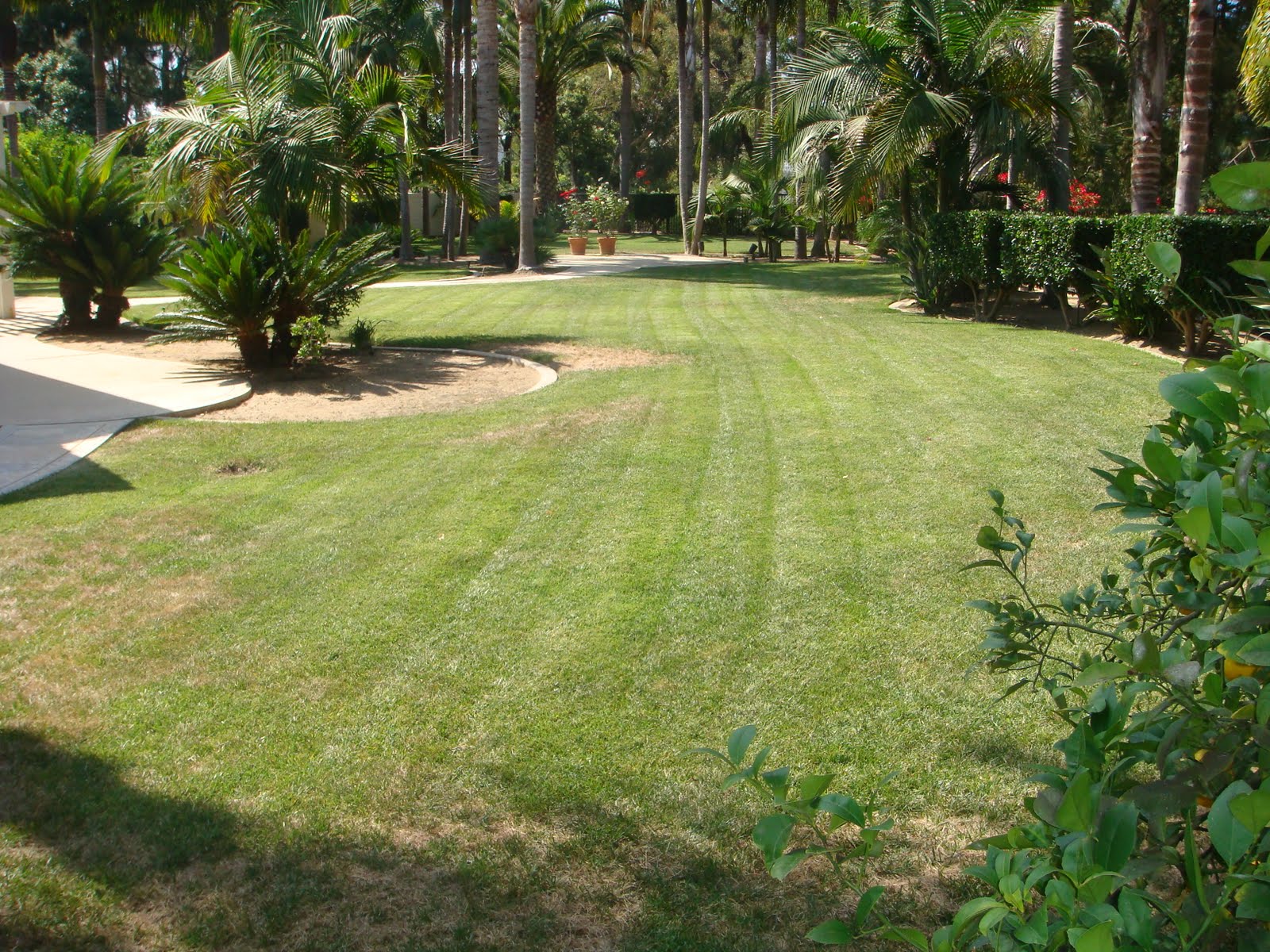
George's beautiful low maintenance lawn:


For more info or to purchase Enviro-Turf lawn seed, please visit our website.

Monday, February 20, 2012

Solving a Lawn Problem in San Diego, California, Part 3

So now I expect you are waiting to see the results of George's efforts to find a lawn that requires much less water than any of his previous lawns.

To summarize what is in Parts 1 and 2, in blog posts below:
"The main reason for replacing the grass was its water consumption and here in Southern California (San Diego) we have the highest cost rates for water from entire United States. So the motivation was strong to find alternatives for customers that still want natural green in their backyards, or go to some artificial solution."
And the results:
"The grass was seeded Oct 1st, 2011. To date the results are OUTSTANDING, from looks to water consumption. First month water usage was 42% lower than same time last year regardless that I watered more than normal to get the grass going, and the past 2 months the water consumption was 58.6% lower than same time last year...Wow !! Very Very impressed and a happy customer."

the new front yard lawn

 
close-up

part of the back yard

more of the beautiful backyard

Want some Enviro-Turf seed for yourself? Visit the Bluestem Nursery website.

Saturday, February 18, 2012

Solving a Lawn Problem in San Diego, California, Part 2

George B, a customer in San Diego, has reported great success with our Enviro-Turf, a low maintenance lawn seed. In the previous post (see below) he talks about his motivation behind the change to Enviro-Turf, and shows pictures of his old lawn.

George also sent us some great pictures of the transformation of his 7,000 sq ft lawn, and explained the steps he took to get rid of the old lawn:

1. Kill old lawn with Roundup, about 3 applications.

2. Wait for lawn to be dry completely


3. Remove dead lawn (by hand to about a depth of 8 to 10 in)

4. Let dead lawn dry


5. Rototill soil and let it dry

6. Remove by hand old grass roots without any soil (I had about 1.5 ton of dead old grass and very little soil)

7. Add about 2" of top soil and rototill soil to about a depth of 6 inches.


8. Rake and final grade

9. Apply "Enviro-Turf Seed"


10. Water as needed to keep the soil moist

Current lawn pictures in the next post.

Thursday, February 16, 2012

Solving a Lawn Problem in San Diego, California, Part 1

Last year George B contacted us because he felt that our Enviro-Turf lawn seed might be the solution to his desire to have a less thirsty lawn in his hot dry climate in San Diego, California.

He sent us this info regarding his motivation behind his change to our Enviro-Turf:
"San Diego has one of the highest water usage rates in the country and for the past three years it has been going up and up much more than the inflation rate. Just in the past 12 months the rate went up two times. As an example this past December water usage was reduced by 56% over same period a year before, but the cost for water usage was reduced by 5.2% ONLY. Can you imagine how much would it have been if it was not for the 56% reduction in consumption?

But the story does not stop there. As the cost over the past 23 years has been going higher and higher, I replaced the entire grass 2 times from the original one (yours being the third time from the original during this period), and I modified the sprinklers 3 times with improved and more efficient type of heads. All in vain because no matter how much the reduction in water (few percentages) the costs still continued claiming

I considered at one point putting in artificial turf but nothing is like natural grass. So the solution had to be a grass that is still a grass, looks good, maintains easily, but most important, has a dramatic reduction in water usage. Enviro-Turf Lawn was the answer, and based on almost 5 months, I believe I hit the "jack-pot" with your product."

This was what the thirsty lawn looked like, despite regular watering:


The next post will show the steps he took to convert to Enviro-Turf and what his new lawn looks like.

Sunday, January 15, 2012

Gardening at High Elevation, in New Mexico

by Sara Douglas Scott


Gardening at 5000 feet in elevation in Albuquerque, NM presents some unique challenges:
· Negligible precipitation: 7-8 inches on average annually.
· Radical daily temperature fluctuations. A 40 degree swing in a day is normal, but up to 60 degree fluctuations occur from time to time.
· Intense sunlight and heat: summer temperatures of at least 90 to 100 degrees and blinding UV year-round.
· Soil lacking organic matter.
· Fiercely dry winds.
In my experience, grasses take this environment in stride. Not surprisingly, Albuquerque and much of New Mexico were once vast grasslands. Of the 29 ornamental grass genera offered by Bluestem, 20 of them (species thereof) are recommended in our New Mexico-specific gardening books and nursery catalogs/websites (see list below). The remaining 9 require either cool temperatures, significant moisture, shade, or acidic soil, or a combination thereof, conditions that do not occur naturally in most gardens here. New Mexico is a large state with many varied microclimates, however, and the intrepid gardener in a mountain or riparian setting, where it is cooler, moister, and/or shadier, might find success growing these more tender grasses (though some extra TLC could be required).

part of Sara's beautiful garden
With the exception of native New Mexican plants, ornamental grasses are the most reliable and hardy group of plants that I have used in my garden. One must remember, however, that they are not (typically) native and will require more thought as to location in the garden and water needs. Before ordering, be sure to consult local gardening resources (books, websites, nurseries, extension services, etc…) as to the particular species and its use and care. If you provide for the needs of the particular grass, however, you will be rewarded with year-round textural interest, a beautiful visual counterpoint for your perennials, and a lovely performance as the grass dances in the wind.

Ornamental grass genera, species thereof, known to grow in New Mexico or parts of New Mexico are (check local resources on particular species):

Thanks to Sara for submitting this information.


Saturday, August 27, 2011

Growing Grasses in Calgary, AB - Part 1


Calgary's Gardeners Deal With a Very Challenging Climate
Fortunately there is an ample selection of grasses for the challenging conditions in the Calgary area, as proven both by controlled hardiness trials at various universities and by the more prosaic trial-and-error methods used by nursery growers and home landscapers.

Below are descriptions of six of the best grasses for the Calgary area. A list of specific grasses will follow in a separate post.

Calamagrostis x acutiflora ‘Karl Foerster’ (Feather reed grass): This hardy, narrow and tall (up to 2 M), cool-season grass grows to its fullest potential in open, sunny areas with extra water during dry spells. However, it is very adaptable and can also be grown in partial shade in a variety of soil types and moisture levels. A single ‘Karl Foerster’ plant makes a striking specimen, but they can also be used to more dramatic effect in greater numbers. A swath of them planted along a border becomes a kinetic weathervane as their upright flowers dance in a breeze.
Follow this link to view further info about "Calamagrostis Karl Foerster" on our website.

Deschampsia cespitosa (Tufted hair grass): In terms of growing conditions, the many forms of Tufted hair grass are similar to ‘Karl Foerster,’ and the two grasses are often planted together. Boasting names such as ‘Bronze Veil,’ ‘Gold Veil,’ and the smaller ‘Gold Dew,’ they reveal Deschampsia’s versatility and charm. Like ‘Karl Foerster’ they start blooming in late June and their flowers persist into winter. Their blooms are large but are so finely textured that they resemble a sublime haze of gold floating above foliage. Both ‘Karl Foerster’ and the green-leaved varieties of Tufted hair grass are great choices that can hold their own against Calgary’s winters.
Follow this link to view further info about Deschampsia on our website.

Carex muskingumensis (Palm sedge) and Luzula sylvatica (Greater wood rush): Even though much of Calgary is dry and sunny, many shady areas occur around buildings and taller vegetation. These niches that have lower light levels are appropriate places to plant Palm sedge and Wood rush. Neither plant is a true grass, but both are good choices for handsome, winter hardy plantings.
Palm sedge (up to 1 M tall) is adaptable, but in natural conditions it favors moist (even wet) areas when it is growing in full sun; in shadier locations it tolerates drier conditions. It is often used in landscaping to display its palm-like foliage which nicely complements perennials with large leaves such as Hosta.
Wood rush is a slow-to-establish small plant that is useful for lightly to moderately shaded areas. Although some protection from winter winds is helpful for reducing dieback of the tips, it is somewhat amazing that Greater wood rush maintains its green color year-round. Also, once it settles in and its roots spread, wood rush is a very tough plant for shade. Its fibrous root system allows it to become a weed-proof groundcover that can handle a fair amount of drought (larger plants are produced if the soil around them isn’t allowed to dry out).
Follow this link to view further info about Luzula sylvatica on our website.

Schizachyrium scoparium (Little bluestem): Native to mixed grass prairie habitat, Little bluestem (50-100 cm tall) is an excellent choice for just about any sunny garden in Calgary. Its fountain of narrow leaves is appealing year-round. The most commonly grown variety – both for hardiness and ornamental qualities – is ‘Blaze,’ whose name conjures an image that captures its fall colour. For a combination that will produce decades of enjoyment, plant large drifts of Little bluestem around groupings of Pinus flexilis (Limber Pine), which grows wild in this region.

Miscanthus sinensis (Chinese silver grass and various other names): If you took a survey of what ornamental grass first captured the public’s attention, the majority would probably say Miscanthus – this wouldn’t be surprising, given Miscanthus’s stunning visual presence and its physical stature, which is closer to shrubs than perennials. Its various cultivars and species come in a range of sizes but they tend to be medium to large. To grow the best specimens it is important to consider micro-climates: The ideal position is a sheltered area that receives at least six hours of summer sun; a good location would be near a southwest-facing wall that reflects extra sunlight in summer and retains some radiant heat in winter. All of the many varieties of this grass are quite attractive, but Miscanthus sinensis var. purpurascens merits special mention: It is winter hardy, its reddish-green foliage and fall color are alluring, and its smaller size allows it to be mixed in with other perennials without overwhelming them.

Thursday, April 28, 2011

Planting Our Bare Root Plants & Plugs


Many of our customers order the bare root Miscanthus plants, particularly Miscanthus Giganteus. Just in case you don't know how to plant it, I have a picture of one below. The green line indicates the soil level. There should be a point where the stalk changes from light to dark. That is the previous soil level. So try to plant it to approximately the same depth again.


For planting the plugs and other bare root plants, we have a video. Sorry it is not as crystal clear as we would like it to be. It became unclear in the upload to YouTube.

Monday, March 28, 2011

For Screening or a Fence: Willow Fedge vs Coppiced Willows

That Jim (6'2"), the owner of Bluestem Nursery, standing amongst
Salix viminalis Superba. That is just one year's growth!
(on the willows, not Jim!)

Willows are great for screening. They put on a lot of growth in a single year, especially when coppiced (cut to ground level) in late winter/early spring.
There are two ways to grow them: upright, which involves putting cuttings in the ground, and building a fedge, which involves putting 6'+ rods into the ground on an angle. Let's consider the pros and cons of a building a fedge vs a simply planting a stand of willows:

Fedge (more info on our website)

Pros:
  • sturdy
  • permanent (meaning year round)
  • unique
  • will keep out deer and other larger animals
  • can be kept narrow
  • gives you screening the first year 
Cons:
  • will require pruning at least twice a year
  • if not pruned the branches will flop and look messy
  • requires some effort to build
  • because of the pruning required, it may not be very tall

A stand of coppiced willow plants

Pros:
  • inexpensive
  • easy
  • requires pruning only in late winter
  • many ways to approach it (see Willows for Screening) on our website 
  • will probably keep out deer, once it grows taller
  • shelters wildlife
Cons:
  • needs to be cut down at some point (however, see the link above)
  • will not give much screening the first year
  • will be quite wide, though stray branches can simply be pruned, at anytime of the year

Tuesday, February 22, 2011

Root Systems of Prairie Plants

A customer pointed out this interesting information, from the Illinois Native Plant Guide, on the root systems of native plants. Since we occasionally get asked about the root depth of our grasses, and because we sell 8 of those shown in the diagram, I thought it may be of interest. Click here to view.

It is a bit difficult to read the names of the plants, so here are those that we carry:
Note that the first one is so small that you may miss it when counting from the left (its Kentucky bluegrass)

Click on the coloured text to go directly to our website to view more info aabout each grass.

Wednesday, February 16, 2011

Nova Scotia Community College - Living Wall

I received a link to this video of a living wall under construction at the Waterfront Campus of NSCC in eastern Canada.

Congratulations to all involved. It looks beautiful!!

Tuesday, February 15, 2011

If You Have Streambank Erosion Issues

From a newsletter we receive:

Streambank Soil Bioengineering: How to Build & Install Vegetative Structures for Reducing Streambank Erosion


Same Agenda, Two Locations:
February 23-24, 2011 Portland, OR
or
March 9-10, 2011 Spokane, WA

"Join us for a very practical, in-depth and applied workshop on building and installing vegetative structures for reducing stream bank erosion. Our two very experienced instructors will cover all aspects from understanding stream functions, and riparian sites to the building, applied uses and life expectancy of stream bank erosion control techniques. A wide variety of designs and applications will be covered with an on-the-ground assessment of what works and what doesn't. The same workshop will be offered in both Portland, OR and Spokane, WA to make your travel plans easier."

For more information and to register, click here.....

Tuesday, January 11, 2011

Living Walls or Vertical Gardens

A vertical wall of greenery is not only aesthically pleasing in concrete jungles, but it also significantly cools the wall.

The vertical garden is not just ivy growing up a wall, rather the plants are rooted in the wall. It is closely related to a green roof.... simply a green roof suspended vertically.

Previous to the Olympics in Vancouver, I had been seen pictures of living walls(aka vertical gardens, green walls, plants walls, biowalls), but I hadn't been able to get up close to one until I saw this one on display during the Olympics. The picture below looks a bit like it could be a bunch of plants at a nursery, waiting to be purchased, doesn't it? However this small panel is hanging vertically and while he plants have not filled out yet, you can see the various colours and textures have created something visually appealing:
To explain the concept, from Wikipedia:
"In vertical gardens, plants are rooted in fibrous material anchored to a wall. Water trickles down between the sheets and feeds moss, vines and other plants. Bacteria on the roots of the plants metabolize air impurities such as volatile organic compounds."
To further develop the idea of using various leaf colours and textures Patrick Blanc has designed many incredible vertical gardens around the world. This one is on the Marché des Halles in Avignon, France:

The overpass below is Pont Max Juvénal, in Aix-en-Provence, France:
A living wall on the CaixaForum, a new museum in Madrid, Spain:
Made by Scotscape Living Walls, in Scotland:

The walls can also be indoors, such as in offices, hotel atriums, etc, to improve the air quality, but I will save that for a future post.

Some further info and pictures can be seen at these websites:

Friday, December 31, 2010

Sod Furniture, Grass Furniture or Organic Furniture

I see that it was way back in 2006 that I discovered some pictures of sod furniture and put them on my own blog. I am guessing that some of you might like to see what wonderful things some creative people are doing with a mound of dirt and some rolls of turf.

I believe that credit can be given to Greg Tate for coming up with the idea. He is responsible for these beauties:


Cornell University has done quite a bit of work in this area, including a video series. This is the first, which is a time-lapse video:


This page has many more videos in the series: Cornell University Living Sculpture, and these pages have more info and links.

For those of you considering making a piece of sod sculpture, I suggest that you visit Cornell's blog, as they have also followed it up with an article title Sod Furniture Revisited: Some Lessons Learned

Instructions for a sod chair can also be found at the bottom of this page at Rumble Pie.

What fun!!!

Thursday, May 20, 2010

Willow Elephants in England

The Brits are miles ahead of us in North America, when it comes to the use of willows for sculpture (though Patrick Doherty and Alastair Heseltine are two notable exceptions).

Here is my latest discovery, from a post that is no long available on The Guardian's website:

"A herd of life-size wicker elephants arrives in Hyde Park today for a two-week stay. The 13 elephants are specially commissioned by charity elephant family, which is working with the Royal Parks Foundation and The World Land Trust to raise awareness about habitat protection projects in the UK and India. Here we chart the elephants' journey from the workshop to the banks of the Serpentine."

 
There are 9 more photos on The Guardian's website, including some of how the elephants were constructed. There are a few more interesting details on the BBC website.

On our website, I have more links to artists who are creating willow scuptures.

Thursday, May 6, 2010

How to Build a Living Willow Dome

When Harriet sent pictures of her living willow structure, I was so impressed that I asked if I could put them on our blog. She not only agreed but sent along a wonderful set of instructions! Thanks Harriet!

Building a Willow House

"Coming from England, I have seen and admired Willow structures for a number of years thinking one day I would build one myself. Having our children rekindled the idea and I searched for a place to find the Willow rods. I finally found Bluestem and ordered my rods for delivery in Spring this year! I ordered 50 rods in total. This is what we did...

What you need:
  • Willow rods
  • Garden twine
  • Weed membrane
  • 12" Planting Dibber or stick to make holes in the ground
  • Compost
  • Bag of Flour!
Step 1
Pick a spot about 40' away from your house or any other structure/building and lay down a membrane to make the floor of the house. Our floor was 8ft square and the rods I think were 8'-9' long.
Note: due to US Post Office shipping restrictions, we ship rods 84" long; in Canada 200cm.

Step 1

Step 2
Find the center of the floor and use a piece of twine and the dibber as a guide while you make a circle using the bag of flour :-)

Step 2

Step 3
Decide where the door will be and choose some sturdy rods to make a doorway (wider than your shoulders so big people can get in too!). Make two holes in the ground through your flour circle with the dibber (about 10"-12" deep) and place your rods in for the doorway. Bend the rods into a cross and twist/weave together.

Step 3

Step 4
Select 6 more strong rods and place them in the ground at equal distances around the circle pointing straight up.

Steps 4 and 5

Step 5
In between each upright rod two more rods need to be placed in the ground; one on a diagonal to the left and one on a diagonal to the right. So when you are done you should have an upright rod, a right and a left rod repeating all the way round.

Step 6
This is where you need 6 pairs of hands, the more people you have to help the better! (we did it with two adults, a three year old and a 7 month old, it was rather amusing, more adults and less kids would have been better) You need to gently bend in your rods so that they have a window about 2' round left open at the top for growth and weaving when the structure grows. While a few hands bend in the rods, another set of hands has to secure the rods in this position with twine whilst weaving the rods in between each other in a very loose basket weave type effort!!

Steps 6, 7 and 8

Step 7
Fill in any gaps you can see with left over rods. Apparently it is best to plant them on the diagonal for maximum coverage when they grow, rather than straight up.

Step 8
Once it was complete, I trimmed the flooring into a circle.

As it grows, I plan to weave in the growth at the top and eventually release the twine holding it together at the moment."

Growth during the first season, along with some happy little girls

Visit the Living Willow Structures page at Bluestem Nursery to purchase rods and for more info regarding all the neat things that you can do with willow rods.

Thursday, April 29, 2010

Living Roof Bench in Alberta, Canada

Carolyn Rallison (who also makes willow baskets, which are shown on our website) sent us this picture of her latest creation - a bench with a living roof. What a talented lady she is!!

I asked Carolyn if she had anything she would like to add:
"I built the bench of spruce limbs and poplar boards. The planting box is lined with pond liner, then a layer of coco mat for drainage. The soil is lean and sandy, as soil that is too rich makes lush and lanky growth. The whole structure is 7 feet tall, 6 feet wide, and 2 feet deep. Last summer was quite dry, so I had to keep it watered; but my intention is to have it "self-sufficient"."

"I first saw and read about green roofs on the internet, then bought a book to read about the subject. I know that there are sod roofs here in Alberta, but have never heard of one with perennials. So I really wanted to give one a try. I planted with assorted perennials and a few annuals for colour: Bearberry, blue flax, alpine poppies, Alpicola primulas, hens & chicks, alpine columbine, species tulips, squill, nemesia & dwarf phlox (annuals). "

"It is just coming through its first winter, so will soon see what has survived! If nothing else, I will just plant it to drought-tolerant annuals every year. I will report on survival rates of the different plants as soon as I know."

Carolyn Rallison
Last West Gardens
Bluffton, Alberta
Zone 3

Thursday, April 8, 2010

Growing Grasses in Cold Climates

If you live in Zone 4 or colder, you would be wise to consider not just the hardiness of the grass, but also whether it can be expected to bloom in your short growing season.

Warm Season Grasses

Warm season grasses tend to have more spectacular blooms, but they also bloom late in the season. If you have a short growing season they may only be just starting to bloom when a hard frost hits. Miscanthus is finished once that happens. The blooms that have opened will remain, but the leaves turn beige and no more blooms are produced.

Here is a list of warm season grasses:
In a climate where the soil does not warm up until mid May or later, there will not be any signs of life from warm season grasses before then. You will be emailing us and telling us your plant(s) have not survived the winter! But they are just waiting for the soil to warm up before they send any leaves up. They thrive in hot weather.

So the use of warm season grasses means that part of your garden will look very bare well into the spring. If you have a lot of garden space planted in warm season grasses, your garden will not show any greenery before late May or maybe even well into June. In a climate with a short growing season you may feel a little cheated. Pennisetum is especially suspenseful because it is the very last to grow, waiting until well into May or even June in a Zones 4 or 5.

Cool Season Grasses

The cool season grasses are much better suited to cold climate gardens. They are in a hurry to produce offspring, so they are up and growing and blooming as quickly as they can. They like the cool weather. So they bloom early, meaning that frost won't ruin the blossoms. Many have blossoms that hang around until winter.

Here is a list of cool season grasses:
Cool season grasses, for the most part, bloom in cool weather and shut down in the heat of summer. If they are not allowed to dry out too much they continue to look good, but they are usually done blooming. Seslerias heufleriana and caerulea bloom with the daffodils!

The four champion/pretty-well-fool-proof grasses in the cool season category are:
  • Calamagrostis, particularly Karl Foerster, our top-selling grass
  • Deschampsia - very hardy and Goldtau is absolutely lovely
  • Festuca - many to choose from
  • Helictotrichon - its evergreen in most climates, so that's a real bonus!
So in climates colder than Zone 3, we recommend only cool season grasses. In Zone 3 we suggest about 80% cool season and in Zone 4 about 60% cool season grasses.

On our website we state the blooming time for a grass. The earlier blooming warm season grasses are the ones to choose in a cool climate. For instance Panicum blooms early and is hardy, so it is a good choice.

Of course we understand a gardener's love of pushing the boundaries, so these are only suggestions. Even I do it. In my Zone 5 garden with early sunset of 5pm, I have a Pampas grass that I have nursed back from near death (because I transplanted it at the wrong time!). Last year it started to look happy, but didn't bloom. Maybe, just maybe it will this year....?